

Gender balance in the boardrooms of the nation’s listed companies is in clear sight, after the number of female directors effectively doubled in less than a decade, data from the Australian Council of Superannuation Investors (ACSI) shows.
In early 2015, when ACSI accelerated its campaign to improve board gender diversity, fewer than 20% of ASX200 directors were women. Now only 30 more appointments of women are needed to hit the target of 40% representation.
ACSI CEO Louise Davidson said approaching the 40% target was a huge milestone considering the arguments which had been raised against increasing female representation.
“The era of male-only boardrooms is ending, because board diversity improves governance standards and helps drive long-term value for shareholders,” she said.
“Ten years ago, when we started this campaign, I sat down to write to every company in the ASX200 with zero or one woman on the board. I was shocked to find that I had to sign 100 letters. Now, you can count that number on your hands.
“ACSI member superannuation funds have successfully pushed for greater gender diversity across the ASX and will continue this work, recognising that a broader range of voices at the decision-making table leads to better decision making and stronger results for investors.”
“However, meeting this target will not be the end of the battle. There are still too many boards that lack meaningful gender diversity with the number of female directors below 40%, or indeed without any women at all. This means they are missing out on a wider talent pool and more diverse skills.”
ACSI has engaged with companies for more than a decade to encourage board diversity, in recent years urging them to set a time frame to reach gender balance. That balance is 40:40:20, comprising 40% men and women with the remaining 20% unallocated to allow flexibility for board renewal. This engagement has been driven by the understanding that boards comprised of individuals with diverse work, technical and cultural experiences are more likely to produce better investment outcomes.
While all ASX200 companies now have at least one woman on their board, it’s a different story in the ASX201-300, where six companies still have male-only boards. Twenty-four ASX300 companies have fewer than 30% female directors. In 2023 ACSI instituted a new voting policy supporting recommendations ‘against’ re-election of male directors in ASX300 companies in which women do not occupy a minimum of 30% of board seats.
“Encouragingly, the data shows that we are seeing new faces and fresh talent joining Australian boards,” Ms Davidson said. “Nearly half (15) of the 34 women appointed to ASX200 boards this year are on their first board appointment and another nine are on their second board.
“We need to do more to support women early in their board careers and encourage women towards board leadership to further lift the performance of Australian businesses, with benefits for all investors. There are currently 13 ASX200 boards with only one woman on them – I would hope to see improvement on that by next year.”
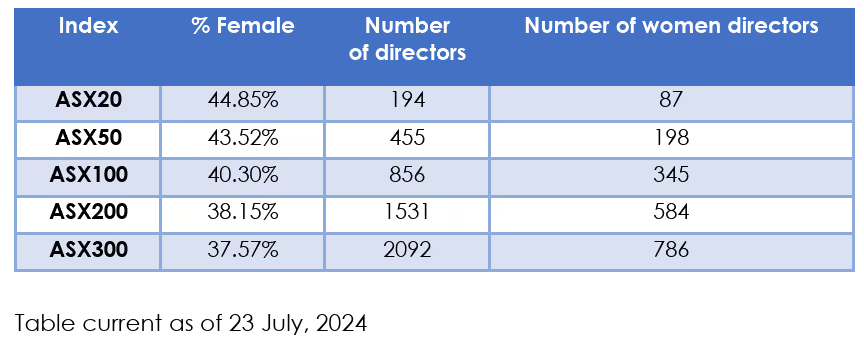
ASX200 board gender diversity progress as at July 2024:
- Only 30 more women directors need to be appointed to achieve the historic outcome of 40% representation (assuming current male directors are swapped for women, rather than increasing board sizes without removing men).
- This comes only five years after reaching 30% (ACSI calculates that the 30% milestone was reached in June 2019). Based on the current rate of change, it is likely the 40% target will be reached by the end of 2024 or in early 2025.
- ASX20, ASX50 and ASX100 all above 40% (see table below)
- ASX200 appointment rate for women in 2024 is running at 44%.
- In 2023 the appointment rate was the highest on record at 46.7%.


.avif)